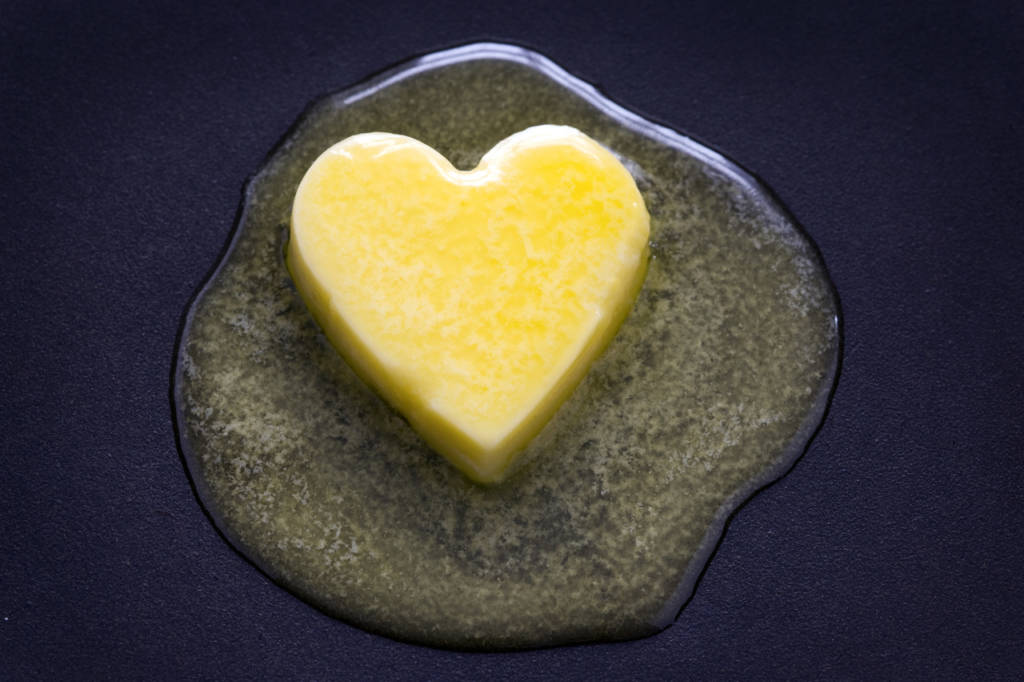
Butter And Cholesterol: Understanding The Impact

Parul Dube
January 25, 2023 - 2:00 pm
Stay updated on the latest and greatest from the world of HealthifyMe. Subscribe to our Newsletter today!
Butter is a key ingredient in many global cuisines, particularly in India, and is commonly used in cooking, baking, and as a topping for bread. However, butter consumption has been a subject of much debate, particularly concerning how it affects cholesterol levels.
Butter production involves churning cream, a milk product that is solid at room temperature and composed of 80% fat. The other 20% is water, proteins, and lactose.
Several variations of butter are available, such as regular butter, salted butter, and unsalted butter. Regular butter contains cream and salt, while unsalted butter simply uses cream. Salted butter is the most popular choice in grocery stores.
Ghee, commonly called as clarified butter, is a common type of butter in India. This butter type is created by simmering butter until the water evaporates and the milk solids separate, leaving a golden liquid. Ghee has more fat than regular butter and has a unique, nutty flavour.
This article will comprehensively examine the link between butter and cholesterol, seeking to distinguish between real evidence and speculations.
Saturated fats, like those found in butter, are known to raise LDL cholesterol levels, commonly referred to as ‘bad’ cholesterol.
Research shows that high LDL levels increase the risk of heart disease. However, not all saturated fats are the same, and other factors can influence the cholesterol-raising effect of these fats. Also, the cholesterol-raising effects of saturated fats may be mitigated by other components in butter, such as fatty acids and vitamins.
Butter contains a small amount of conjugated linoleic acid (CLA), which has anti-inflammatory and anti-cancer properties. Butter also contains small amounts of vitamin K2, vital for maintaining healthy bones.
Research suggests that replacing saturated fats with unsaturated fats, such as those found in nuts, seeds, and avocados, may lower LDL cholesterol levels.
However, it is essential to remember that butter is not the only food containing saturated fat; it is also present in red meat, cheese, and full-fat dairy products. Therefore, it is essential to consider overall saturated fat intake rather than singling out one food item.
Recent research contradicts the common perception that all forms of saturated fat are harmful. Prospective observational studies and randomised controlled trials have not found an association between higher total SAFA intakes and higher incident CHD events or mortality.
However, the research did not consider the replacement nutrients and was limited, making it inconclusive. The researchers suggest that replacing saturated fats with polyunsaturated fats could reduce the risk of cardiovascular disease.
It is important to remember that one should consume butter in moderation as part of a balanced diet. In addition, it should not be the only source of fat. A nutritious diet is beneficial, including fruits, vegetables, whole grains, lean proteins, and healthy fats, such as olive oil, avocado, and nuts. It can help reduce the risk of heart disease and boost overall health.
It is also essential to be aware of the other sources of saturated fat in the diet. The American Heart Association (AHA) suggests that individuals strive for a diet that contains no more than 5-6% of their daily caloric intake in the form of saturated fat. For example, if you require approximately 2,000 calories per day, no more than 120 calories should come from saturated fat. It is roughly equivalent to 13 grams of saturated fat each day.
Another type of cholesterol is HDL (high-density lipoprotein), also known as “good” cholesterol. This type of cholesterol helps remove LDL cholesterol from the bloodstream.
Therefore a higher HDL cholesterol level can help decrease the risk of heart disease. According to a study, butter can also increase good cholesterol in the system more than a habitual diet.
Read more: Top Foods to Increase Good Cholesterol Levels!
People who suffer from hypercholesterolemia, a condition where the body observes more LDLs, should limit their butter intake. In contrast, people with normal cholesterol levels can eat butter in moderation.
Ghee, which is the Indian version of clarified butter, shows dominance in Ayurveda and in preventing heart diseases too.
As per this research, the consumption of ghee would not increase the risks of cardiovascular disorders. The same study claims that men in rural India are prone to fewer coronary heart risks with a higher intake of ghee. So this means that clarified butter is good for cholesterol.
If you are worried about your cholesterol levels or overall health, there are healthier alternatives to butter that you can use. For example, olive oil, avocado oil and coconut oil are all high in monounsaturated and polyunsaturated fats, which are good for your heart health. You can also talk to a healthcare professional or registered nutritionist from HealthifyMe for personalised advice.
Although high in saturated fat, butter can still provide some health benefits. It is a good source of vitamin A, which is necessary for healthy vision, and vitamin K, which is important for bone health.
Additionally, butter made from grass-fed cows may contain higher levels of CLA, a type of fat with anti-cancer properties.
A study found that moderate consumption of butter instead of carbohydrates or saturated fats may not significantly affect cardiovascular disease risk.
However, be mindful of your intake of saturated fat from butter and other sources, as it can raise your LDL cholesterol levels and increase your risk of heart disease.
Moderate butter consumption can have some health benefits. It is a good source of healthy fats, including saturated fats, which can help to increase levels of good cholesterol in the body.
Butter is also a natural source of vitamin A, vital for maintaining healthy skin, eyes, and immune systems. Additionally, butter is a rich source of fat-soluble vitamins, such as vitamin K2, which can help to promote bone health.
To summarise, butter can be part of a healthy diet, but one should consume it in moderation. Replacing saturated fats with unsaturated fats can help to lower LDL cholesterol levels and reduce the risk of heart disease.
Ultimately, it is best to speak to a healthcare professional before making any dietary modifications. It is vital to have an overall balanced diet for optimal health rather than focusing on one particular food.
1. Ueda P, Gulayin P, Danaei G (2018) Long-term moderately elevated LDL-cholesterol and blood pressure and risk of coronary heart disease. PLoS ONE 13(7): e0200017. https://doi.org/10.1371/journal.pone.0200017
https://journals.plos.org/plosone/article?id=10.1371/journal.pone.0200017
2. Hodson L, Skeaff CM, Chisholm WA. The effect of replacing dietary saturated fat with polyunsaturated or monounsaturated fat on plasma lipids in free-living young adults. Eur J Clin Nutr. 2001 Oct;55(10):908-15. doi: 10.1038/sj.ejcn.1601234. PMID: 11593354.
https://pubmed.ncbi.nlm.nih.gov/11593354/
3. Nettleton JA, Brouwer IA, Geleijnse JM, Hornstra G. Saturated Fat Consumption and Risk of Coronary Heart Disease and Ischemic Stroke: A Science Update. Ann Nutr Metab. 2017;70(1):26-33. doi: 10.1159/000455681. Epub 2017 Jan 27. PMID: 28125802; PMCID: PMC5475232.
https://www.ncbi.nlm.nih.gov/pmc/articles/PMC5475232/
4. American Heart Association
https://www.heart.org/en/healthy-living/healthy-eating/eat-smart/fats/saturated-fats
5. Engel S, Tholstrup T. Butter increased total and LDL cholesterol compared with olive oil but resulted in higher HDL cholesterol compared with a habitual diet. Am J Clin Nutr. 2015 Aug;102(2):309-15. doi: 10.3945/ajcn.115.112227. Epub 2015 Jul 1. PMID: 26135349.
https://pubmed.ncbi.nlm.nih.gov/26135349/
6. Sharma H, Zhang X, Dwivedi C. The effect of ghee (clarified butter) on serum lipid levels and microsomal lipid peroxidation. Ayu. 2010 Apr;31(2):134-40. doi: 10.4103/0974-8520.72361. PMID: 22131700; PMCID: PMC3215354.
https://www.ncbi.nlm.nih.gov/pmc/articles/PMC3215354/
7. Siri-Tarino PW, Sun Q, Hu FB, Krauss RM. Saturated fat, carbohydrates, and cardiovascular disease. Am J Clin Nutr. 2010 Mar;91(3):502-9. doi: 10.3945/ajcn.2008.26285. Epub 2010 Jan 20. PMID: 20089734; PMCID: PMC2824150.

When the samosas and pakodas you enjoy on rainy days start showing in your blood reports, you know it is time to take stock. High cholesterol is a major risk factor for developing heart disease which kills three times more people than breast cancer and twice as many as lung cancer. Popping pills is easy […]
By Parul Dube

The human body contains wax-like substances called cholesterol. They are found in blood cells throughout the body. The liver produces this substance that plays a major role in digestion. However, having too much of it in the blood is detrimental for health as it blocks the arteries in the body and leads to peripheral artery […]
By Parul Dube

Cholesterol is an organic compound that our body produces to help build cell membranes and produce hormones such as testosterone and estrogen. Most of the cholesterol required for our bodily processes are naturally produced by our liver. The rest is obtained from dairy products, meat, eggs, fish, poultry and other such dietary sources. The liver […]
By Parul Dube

Medically reviewed by
Gautham Shankar
PHD in colouring hair in darkness